WHITING WHITING WHITING WHITING WHITING
  • Foundation ▼ ▲
    • Home
    • People
    • History
    • Contact
  • Literature ▼ ▲
    • Whiting Award
      • About
      • Current Winners
      • Browse Winners
      • Search All Winners
      • Keynotes
    • Nonfiction Grant
      • About
      • Grantees
    • Magazine Prizes
      • About
      • Winners
    • Discover Writing
      • New Books
      • Chapbooks
      • Videos
      • Random Winner
  • Humanities ▼ ▲
    • Preserving Heritage
    • High Schools
    • Past Programs
      • About
      • PEP Fellows
      • PEP Seed Grantees
      • Dissertation Fellows
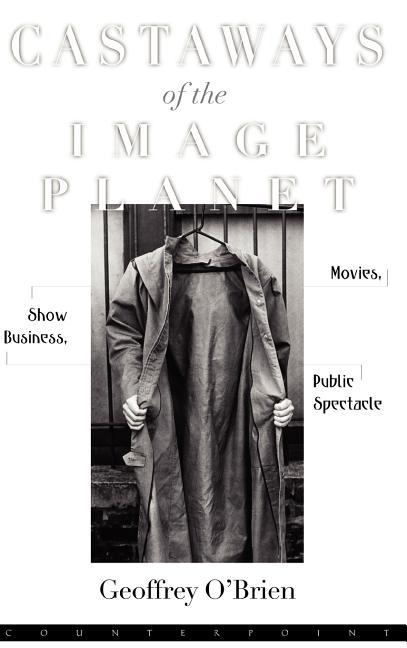
Castaways of the Image Planet
Movies, Show Business, Public Spectacle

Castaways of the Image Planet collects sixteen years' worth of Geoffrey O'Brien's essays on film and popular culture, most originally published in The New York Review of Books, The New Republic, Film Comment, Filmmaker, and The New York Times.

The topics range from the invention of cinema to contemporary F-X aesthetics; from Shakespeare films to "Seinfeld"; from '30's screwball comedies to Hong Kong martial-arts movies; from the roots of sexploitation pictures to the televising of Bill Clinton's grand jury testimony. There is an emphasis on the unpredictable interactions between film as a medium apt for expressing the most private dreams and film as the mass literature of the modern world, subject to all the pressures of financing and marketing. Many of the pieces are profiles of individual directors or actors—Orson Welles, Michael Powell, Ed Wood, Marlon Brando, Alfred Hitchcock, Dana Andrews, The Marx Brothers, Bing Crosby—whose careers are probed to look for the point where private obsession meets public myth-making.
  • Print Books
  • Find your local bookstore (via IndieBound)
  • Powell's
  • Barnes & Noble
  • Alibris
  • Abe Books
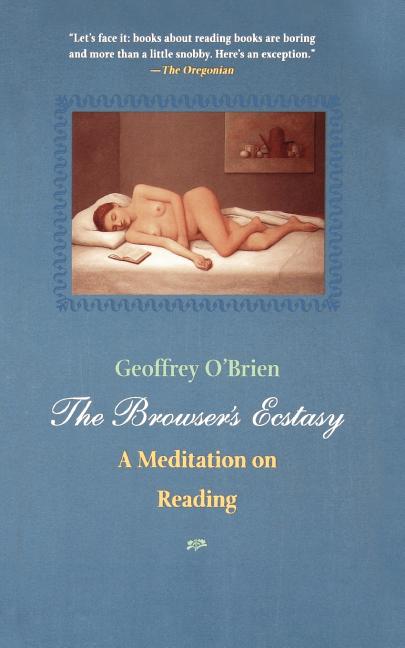
The Browser's Ecstasy
A Meditation on Reading

From one of the most original writers now at work, an expansive, learned, and utterly charming reverie on what it means to be lost in a book.

In The Browser's Ecstasy , O'Brien has written a prose poem about reading, a playful, epigrammatic nocturne upon the dream-state one falls into when "lost in a book," upon the uncanny, trancelike pleasure of making silent marks on paper utter sounds inside one's head. We call The Browser's Ecstasy a "Meditation on Reading," but like any truly original book—and especially the short book that goes both far and deep—it resists easy summary and classification. As Luc Sante once wrote, "The density of O'Brien's work makes word count irrelevant as an index of substance; he is seemingly capable of compressing entire encyclopedias into his parenthetical asides. I defy you to name any precedent for what he does. He's a school unto himself."

  • Print Books
  • Find your local bookstore (via IndieBound)
  • Powell's
  • Barnes & Noble
  • Alibris
  • Abe Books
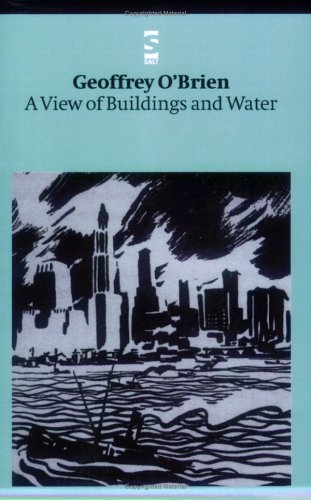
A View of Buildings and Water
Poems

This title collects poems from the last half-decade, ranging from a monologue from an unmade film noir to a sonic sculpture where sense is driven by sound. The narratives take their form from the myth-making of ordinary life, partly found and partly invented, out of which we try to forge a connection between what has vanished and what is yet to come.

  • Print Books
  • Find your local bookstore (via IndieBound)
  • Powell's
  • Barnes & Noble
  • Alibris
  • Abe Books
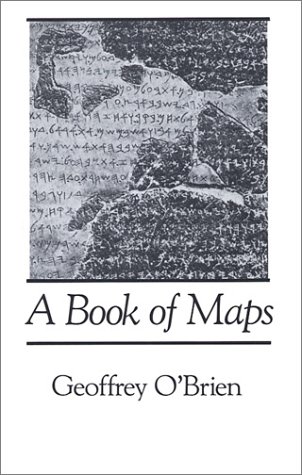
A Book of Maps
Poems
"Words for O'Brien are living things . . . what at first might appear spare, when taken up by the mind blossoms into meaning and sensual detail." —August Kleinzahler
  • Print Books
  • Find your local bookstore (via IndieBound)
  • Powell's
  • Barnes & Noble
  • Alibris
  • Abe Books
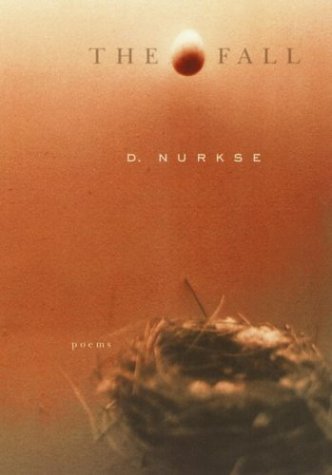
The Fall
Poems

In this elegant collection, D. Nurkse elegizes a lost father, a foreshortened childhood, and a young marriage. From the drenched lawns of suburbia to the streets of Brooklyn, he delivers up the small but crucial epiphanies that propel an American coming-of-age and chronicles the development of a tender yet exacting consciousness. As the diversions of childhood prefigure the heartbreak of adulthood, Nurkse captures the exquisite sadness of each small “fall” that carries us further from our early innocence. In the book’s final section, the poet turns to face mortality with a series of stirring poems about illness in midlife. Throughout, Nurkse celebrates the sheer strangeness of our perceptions in a language that is both astute and surpassingly lyrical.

  • Print Books
  • Find your local bookstore (via IndieBound)
  • Powell's
  • Barnes & Noble
  • Alibris
  • Abe Books
The Border Kingdom
Poems

In a collection of urgent and intimate poems, D. Nurkse explores the biblical past and the terrifying politics of the present with which it resonates, the legacy of fathers and the flawed kingdoms they leave their sons. A poet of unique force and sensitivity, Nurkse refuses to pass over the marginal characters and corners of the world, attuned to the scraps of beauty or insight they might offer up in the midst of moral darkness.

  • Print Books
  • Find your local bookstore (via IndieBound)
  • Powell's
  • Barnes & Noble
  • Alibris
  • Abe Books
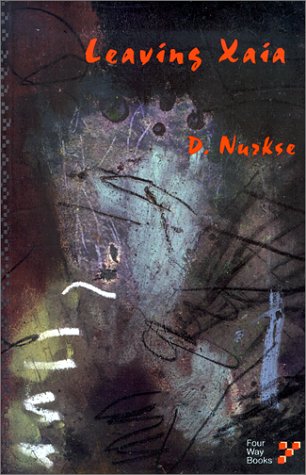
Leaving Xaia
Poems

"Leaving Xaia is a book one can wholeheartedly recommend for its engagement with worldly themes, its accessibility cloaked in a vivid poetic imagination and swabbed with plenty of wise and acute observation. He is part Stephen Dunn and part C.K. Williams—two of the finest, truest poets of our time rolled together—but he is characteristically and particularly Nurkse, himself, and no other." —Cortland Review

  • Print Books
  • Find your local bookstore (via IndieBound)
  • Powell's
  • Barnes & Noble
  • Alibris
  • Abe Books
  • Four Way Books
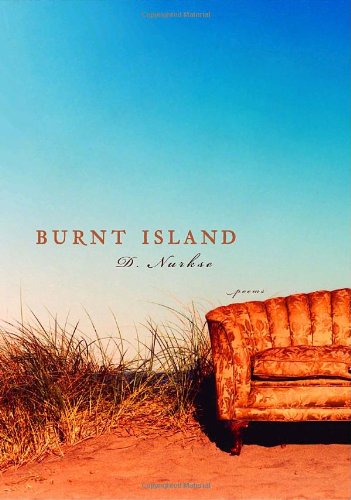
Burnt Island
Poems

D. Nurkse’s Burnt Island explores tragedy both grand and intimate, in city and country, in our own troubled moment and across the greater scope of geological time. Arranged in three “suites” of lucid, often heart-wrenching verse, the book begins with a city under siege, in a group of poems that becomes a subtle homage to New York after 9/11—a metaphorical “burnt island,” where diggers doze on their shovels, citizens contribute bottles of water, M&M’s, and casseroles to recovery efforts, and survivors, mesmerized by the photos of the missing, compare them “scar by scar with the faces of the living.” Nurkse then takes up the journey of a couple starting again in nature at a specific place called Burnt Island, where the elements instruct them, seeming to mirror their conflicts and strife. Finally, in a charming and profound series of poems centered on marine ecology, he finds the infinite in the infinitesimally small, and offers us, in sparkling, mysterious verses, the strange comfort that comes with observing the life of the ocean.

  • Print Books
  • Find your local bookstore (via IndieBound)
  • Powell's
  • Barnes & Noble
  • Alibris
  • Abe Books
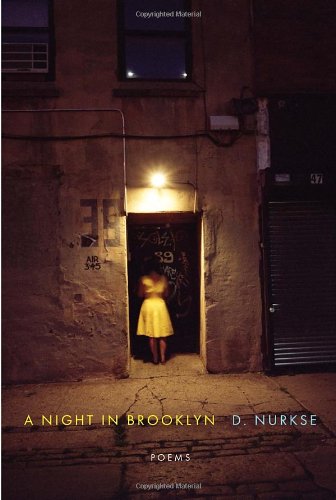
A Night in Brooklyn
Poems

D. Nurkse’s deeply satisfying new collection is a haunted love letter to the far corners of his hometown, Brooklyn, New York, and a meditation on the selves that were left behind in those indelible places.

Here Nurkse brings alive the particular details that shape a life, in this case unique to the world of Brooklyn—a job at the Arnold Grill, “topping off drafts with a paddle” for the truckers who came in; the deaf white alley cat that mysteriously survived the winter on a stoop in Bensonhurst; the narrow bed where young love took place; the wild gardens behind the tenements. His exploration of this almost mythic city past is combined with a sense of the future speeding toward us—the ongoing riddle of time and being in a larger universe.

  • Print Books
  • Find your local bookstore (via IndieBound)
  • Powell's
  • Barnes & Noble
  • Alibris
  • Abe Books
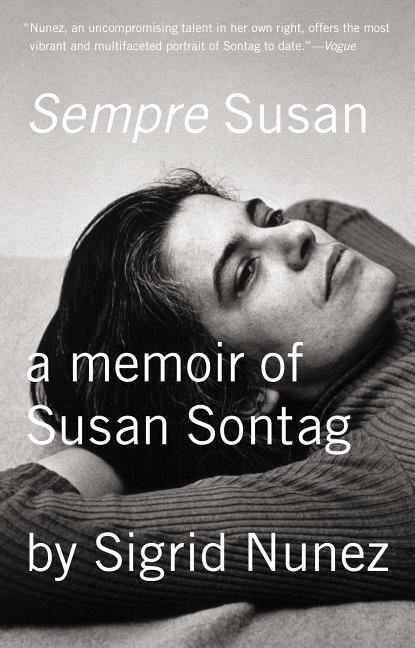
Sempre Susan
A Memoir of Susan Sontag

A poignant, intimate memoir of one of America’s most esteemed and fascinating cultural figures, and a deeply felt tribute.

Sigrid Nunez was an aspiring writer when she first met Susan Sontag, already a legendary figure known for her polemical essays, blinding intelligence, and edgy personal style. Sontag introduced Nunez to her son, the writer David Rieff, and the two began dating. Soon Nunez moved into the apartment that Rieff and Sontag shared. As Sontag told Nunez, “Who says we have to live like everyone else?” Sontag’s influence on Nunez, who went on to become a successful novelist, would be profound. Described by Nunez as “a natural mentor” who saw educating others as both a moral obligation and a source of endless pleasure, Sontag inevitably infected those around her with her many cultural and intellectual passions. In this poignant, intimate memoir, Nunez speaks of her gratitude for having had, as an early model, “someone who held such an exalted, unironic view of the writer’s vocation.” Published more than six years after Sontag’s death, Sempre Susan is a startlingly truthful portrait of this outsized personality, who made being an intellectual a glamorous occupation.

  • Print Books
  • Find your local bookstore (via IndieBound)
  • Powell's
  • Barnes & Noble
  • Alibris
  • Abe Books

Pagination

  • Previous page ‹‹
  • Page 72
  • Next page ››
Subscribe to M

Sitemap Menu

  • Foundation
    • Home
    • People
    • History
    • Contact
  • Literature
    • Whiting Award
    • Nonfiction Grant
    • Magazine Prizes
    • Discover Writing
  • Humanities
    • Preserving Heritage
    • High Schools
    • Past Programs


  • Accessibility Notice Accessibility Notice
  • PRIVACY & TERMS
  • © WHITING FOUNDATION
  •  
Site by PASTPRESENTFUTURE, with design by Language Arts