Both and Neither
The project:
Both and Neither is a work of memoir and haunted nonfiction about life beyond the binary. Because genre and gender come from the same root, Alex Marzano-Lesnevich has chosen a trans-genre approach to write a transgender story. Through memoir, they ask how we see, or fail to see, ourselves and others. Alongside memoir, they utilize an archival thread to reinvestigate the stories of four historical figures, stories that were once invisible to them, deriving a transmasculine lineage from those who transcended gender in the same geographic places that Marzano-Lesnevich now inhabits. As the book progresses, Marzano-Lesnevich asks how to make a life in a culture that would deny, suppress, and harm trans people. To ask to be seen is to ask how to be loved is to ask how to live—answers to which can only be found in community, across time.
From Both and Neither:
The year is 1855 and there are, immediately, rumors about the singing teacher who has arrived in town. His age—he is said to be in his twenties, but with his smooth jawline, something soft about his face, looks younger. His bearing—he is formal with the mothers, unfailingly courteous, reassuring to them about how much potential he sees in their daughters.
And among those daughters? He is a sensation. I picture him now, and if I want to make this part fun, who can blame me? If my imaginings are fantasy, so be it, for they are no more fantasy than the historical record is, a record only of officialdom and pain, of ostracization and violence, history’s fantasy therefore of a life stripped bare of pleasure for one’s failure to conform.
To hell with that. In Bethany, Pennsylvania, Joseph is having fun—a train has carried him only 35 miles south, but he has found a town in which no one recognizes his face from the papers, no one bears attachments to his family, he is no longer the “lady hunter.” A whole life of contained loneliness transformed now, somehow, to the object of all these girls’ shy, sly looking. They wear wide silk and linen dresses with necklines he reckons they must have bargained with their mothers over, unless—he enjoys this thought even more, perhaps, its intimation of respectability—the mothers noted his unmarried status and themselves urged the daughters into these dresses that show their creamy clavicles, their silvered throats. He himself dresses carefully each morning he will see them. In the old mirror propped up against a dresser in the boarding house where he stays, he watches himself grasp a strip of muslin and pull it tightly around his chest, as tightly as he can stand. The end he tucks in so what was wrapped previously will secure it, then fastens a pin through the closure, taking care. Too many times the pin has come undone through the day and stabs him when he demonstrates for the young ladies how to brace their shoulders, square themselves, and fill their lungs with air. He rests a hand on his abdomen then so they can see the way the air fills him. Watch how breath bellows out the space that once was.
No surgery was available to him. No hormones. So when I follow Joseph as he walks along a narrow, wooded lane from the last home of the day on his route, back to the boarding house, it is his body I am thinking of, his body I can imagine only through my own. The cool kiss of the night air against his cheekbones, the scent of cedar and fir, the bright slice of moon above and the dusting of stars. Perhaps an owl hoots in the distance. Perhaps a barn swallow headed home to his roost for the night swoops low over his shoulder, and perhaps that barn swallow is me and I am the ghost of the future, watching him now.
The grant jury: Powerfully and beautifully crafted, Both and Neither blends memoir and history with rare sensitivity, bringing to life trans experiences—past and present—with grace, intellect, and unflinching honesty. Alex Marzano-Lesnevich manages to combine ambitious research with deeply personal reflection, illuminating a history long obscured while reminding us that no one walks their path alone. A timely and profoundly moving work which feels especially urgent at this moment in our culture when anti-trans sentiment is surging.
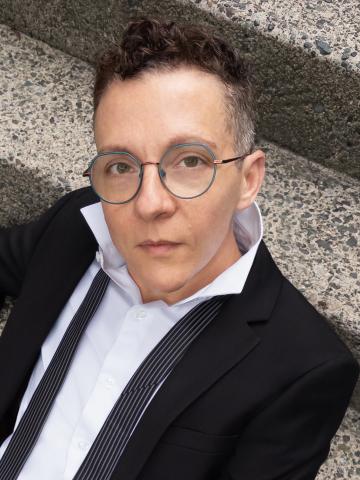
Alex Marzano-Lesnevich is the author of The Fact of a Body: A Murder and a Memoir, which received a Lambda Literary Award, the Chautauqua Prize, the Grand Prix des lectrices de Elle, the Prix des libraires du Quebec, and the Prix France Inter-JDD. It has been translated into 11 languages. Their essays appear in the 2020 and 2022 editions of Best American Essays as well as The New York Times, Harper’s, Agni, Yale Review, and other publications. A 2023 United States Artists fellow and three-time fellow at both MacDowell and Yaddo, they are the Rogers Communications Chair in Creative Nonfiction and an assistant professor at the University of British Columbia in Vancouver, Canada.
Selected Works