Empires Between Us: Estrangement and Kinship Across Three Continents
The project:
Empires Between Us reckons with solidarity and its limits in a post-colonial age through interrogating the author’s experiences as a South Asian-Canadian aid worker in Africa. This book explores estrangement in many forms—across families, castes, and cultures—by examining the author’s relationships with other descendants of the colonized; researching the histories that entangle and divide them; and reporting on places degraded and (at least partially) defined by colonialism’s afterlife. Eventually, this peripatetic journey—between the lived and the researched; between Africa, Canada and India; and between the present and the historical—also surfaces unexpected types of kinship. Ultimately, Empires Between Us presents a vision of alternative intimacies spanning race, class, and borders.
From Empires Between Us:
As the sun reached its zenith in Timbuktu, I saw Alhous a half mile away, talking to a boy about ten or eleven years old. He wore a Pink Panther t-shirt and his right leg was missing. His crutches were crudely fashioned from tree branches. The leg of his shorts flapped wildly in the wind.
I went over to them. Alhous explained the boy had found a black ball near his house and bounced it. That was all he remembered before waking at the clinic with his leg amputated.
My tongue felt thick in my mouth. “What’s his name?” I asked.
Alhous turned to the boy, who looked nervous, and asked him in Bambara. “Amadou,” the boy said.
I took out my notebook, writing down his name and the story of his accident. Then, I pointed to my camera and raised my eyebrows at Amadou, asking for permission. When he nodded, I crouched down so the photo would be at eye-level. Click.
I turned the screen towards him so he could see himself. As he looked, his face seemed to fall apart. His jaw loosened. His eyes widened then squeezed shut, as if to block out what he saw. He moved to walk away, the ends of his crutches sinking in the sand and slowing his escape.
Alhous didn't move to stop him. Like me, he simply watched, pain puckering both our faces. For a moment, I felt a perverse satisfaction. Alhous was no different than me now: both of us outsiders to this place. Both of us culpable in another’s pain.
Later, I wondered if Amadou simply hadn’t seen a photo of himself since losing the limb. Maybe that encounter, so late in his young life, scared him a little. Maybe. But I couldn’t shake the feeling that something else was at play. That even though I’d asked permission to take his photo, I’d failed to ask for real consent. But what would that have looked like? Asking his parents? Would it have meant looking beyond his injuries, or looking away from them? Would it have meant not photographing him at all, leaving him unseen by anyone outside Timbuktu? Was that preferable to his image being passed around in the halls of the UN and the French Development Agency?
Alhous would have been a natural person to talk to about all this. But we never discussed what happened. It felt taboo, like we’d committed a sin that would only be deepened by speaking of it. A collective guilt descended on us, rendering us mute. “Shared shame,” some psychologists called it. Others labeled it “a conspiracy of silence.” Whatever it was, it was powerful. We were silent driving to the airport. On the flight back to Bamako, he ran his hands over his forearms as if chilled even though the plane’s AC was broken, heating its interior to an inferno.
It felt impossible to talk, but without talking, it felt equally impossible to parse what had transpired. And maybe it was this unspeakable silence—one I suspected I’d face again and again if I stayed in this job, with its moral quandaries around every corner—that made me start questioning what other tolls staying would exact on me. What sort of belonging was truly possible for me here, and what price was I willing to pay for it? Or did my assumption that belonging could be bought doom me from the start?
The grant jury: Raksha Vasudevan’s Empires Between Us presents a nuanced exploration of post-colonial aid work from the author’s South Asian-Canadian perspective. Interrogating the complex politics of kinship and complicity, Vasudevan moves beyond simplistic narratives of Western saviors and Southern recipients. Her analysis provides a considered perspective on the moral ambiguities in cross-cultural aid, shaped by histories of colonialism in India, Africa, and Canada. Through personal recollections and keen cultural critique, she reveals how power structures influence her own life and work. The book is a compelling, authoritative guide to the intricate dynamics of modern global relations.
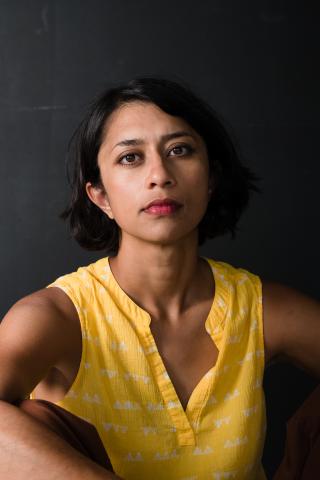
Raksha Vasudevan is a writer and former aid worker who was born in India and raised in Canada. After a half-decade working in East and West Africa for various nonprofits and startups, she turned to journalism. Now based in Denver, she has reported on issues of race, environmental justice, housing, and "progress" for The New York Times, VICE, The Guardian, Outside, and High Country News, where she was also a contributing editor. Her essays and commentary on colonial legacy and family estrangement appear in The New York Times Magazine, Harper's Bazaar, Guernica, and Hazlitt, among others. Her writing has received support from UCross, Mesa Refuge, Storyknife, Banff Centre for Arts and Creativity, the Canada Council for the Arts, and the Writers' Trust of Canada.